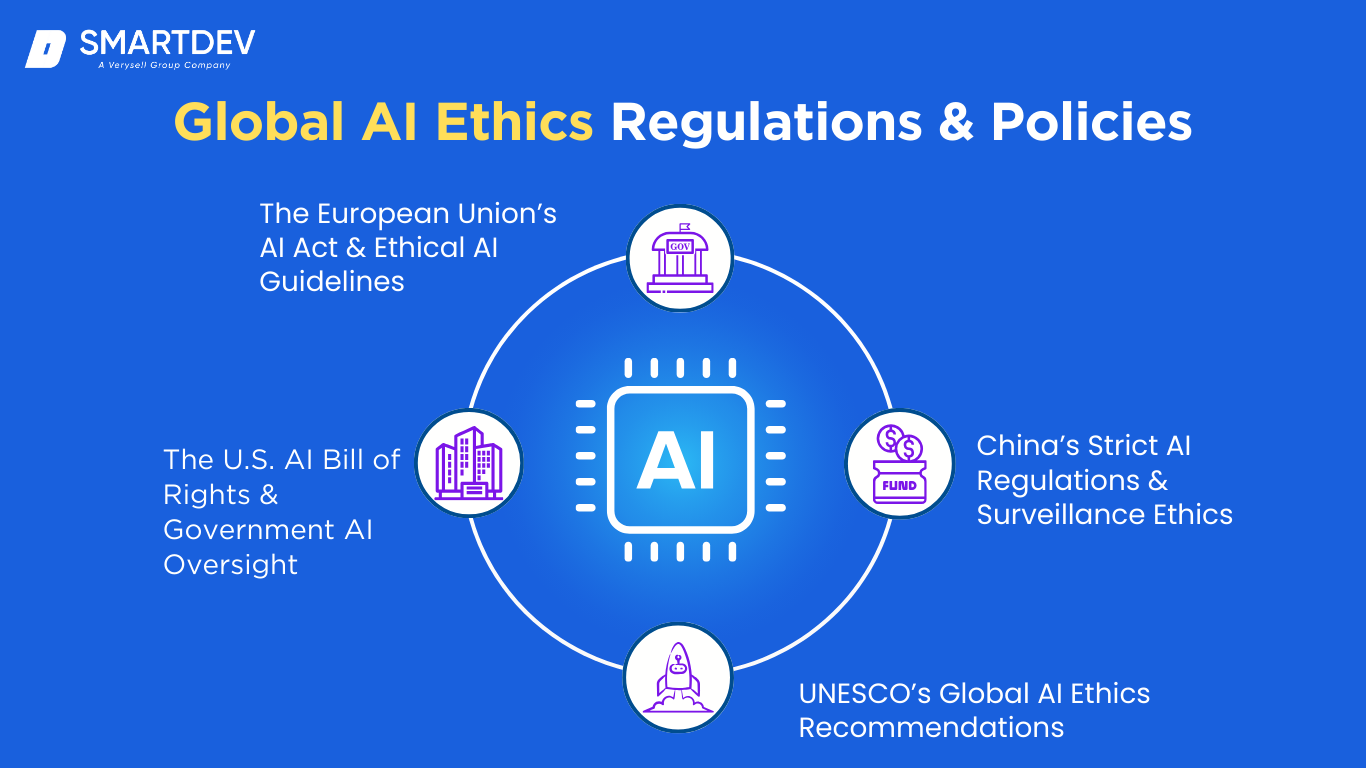
In 2025, AI ethics is no longer optional—it’s a regulatory and business imperative. Governments, industry bodies, and customers increasingly demand transparency, accountability, and fairness from AI systems. Non-compliance can result in hefty fines, reputational damage, restricted market access, and even criminal liability in some jurisdictions.
This guide provides a clear, up-to-date overview of the major AI ethics regulations and compliance requirements businesses face in December 2025, with practical steps to build a compliant AI program.
Major AI Regulations and Frameworks in 2025
| Regulation / Framework | Jurisdiction | Effective Date | Risk-Based Approach | Key Requirements | Penalties (max) |
|---|---|---|---|---|---|
| EU AI Act | European Union | Aug 2024 (phased) | Yes (4 tiers) | Transparency, risk assessments, human oversight for high-risk systems | Up to €35M or 7% global revenue |
| California AI Transparency Act (SB 1047) | California, USA | Jan 2025 | Yes | Safety testing for frontier models, incident reporting, public risk assessments | Up to $10M + civil penalties |
| Colorado AI Act | Colorado, USA | Feb 2026 | Yes | Algorithmic impact assessments, consumer rights, bias audits | $20K per violation |
| New York AI Bias Law | New York, USA | Jul 2025 | Yes | Annual bias audits for automated decision tools in hiring & lending | $1K–$5K per violation |
| China AI Governance Framework | China | Ongoing | Yes | Content safety, data localization, government approval for certain models | Business suspension |
| Singapore Model AI Governance Framework | Singapore | Updated 2025 | Voluntary (but expected) | Accountability, transparency, fairness, data quality | Reputational risk |
| NIST AI Risk Management Framework 1.0 | USA (voluntary) | 2023–2025 | Yes | Govern, Map, Measure, Manage risk | No direct penalties |
| ISO/IEC 42001:2023 | Global (voluntary) | 2023–2025 | Yes | AI management system standard (certifiable) | Certification prestige |
Key Compliance Themes Across Regulations
- Risk Classification Most frameworks classify AI systems by risk level (minimal, limited, high, unacceptable). High-risk systems (e.g., hiring, credit scoring, medical diagnostics) face the strictest requirements.
- Transparency & Explainability Users must be informed when they interact with AI. High-risk systems often require detailed technical documentation and explainable outputs.
- Bias & Fairness Audits Regular testing for bias across protected characteristics (race, gender, age, disability, etc.) is mandatory in many jurisdictions.
- Data Governance & Privacy Compliance with GDPR, CCPA, and emerging data protection laws is non-negotiable. Models trained on personal data must follow strict rules.
- Human Oversight & Accountability Critical decisions must include human review or escalation paths.
- Incident Reporting Serious AI incidents (harm to individuals, security breaches) must be reported to regulators within days or weeks.
- Conformity Assessments & Registration High-risk systems often require third-party audits and registration in public databases (e.g., EU AI database).
Practical Steps to Build an AI Ethics & Compliance Program in 2025
1. Appoint an AI Governance Lead
- Create a cross-functional AI Ethics Committee (legal, engineering, product, compliance)
- Designate a Chief AI Officer or Ethics Officer
2. Conduct an AI Inventory
- Catalog every AI system in use or development
- Classify each by risk level according to applicable regulations
3. Implement Risk Assessments & Documentation
- Use templates from NIST, EU AI Act, or ISO 42001
- Document data sources, model architecture, training process, and bias mitigation steps
4. Build Technical Safeguards
- Use fairness toolkits (Fairlearn, AIF360)
- Implement logging, audit trails, and monitoring
- Adopt explainability tools (SHAP, LIME, or native model features)
5. Train Your Teams
- Mandatory AI ethics training for engineers, product managers, and executives
- Create clear internal policies on acceptable AI use
6. Engage Third-Party Auditors
- For high-risk systems, hire accredited auditors (e.g., TÜV, Deloitte, PwC)
- Pursue ISO 42001 certification for credibility
7. Prepare for Reporting & Transparency
- Build incident response plans
- Create public AI transparency reports (many companies now publish annual reports)
Quick Checklist for 2025 Compliance Readiness
- AI inventory completed and risk-classified
- Bias audits performed on high-risk systems
- Human oversight mechanisms in place
- Documentation and technical files ready
- Staff trained on AI ethics policies
- Incident reporting process established
- Third-party audit scheduled (if required)
The Business Case for Compliance
Beyond avoiding fines, compliant organizations gain:
- Stronger customer trust
- Easier access to enterprise contracts
- Competitive advantage in regulated industries
- Reduced legal and reputational risk
Final Thoughts
In December 2025, AI ethics regulations have moved from “coming soon” to “here now.” Businesses that treat compliance as a strategic priority—rather than a last-minute checkbox—will be best positioned for growth in an increasingly regulated AI landscape.
Start by mapping your AI systems to the regulations that apply to your geography and industry. Even if you’re not yet subject to strict rules, adopting best practices today will save significant time and cost tomorrow.
Have you started your AI compliance program yet? Which regulation is most challenging for your organization? Share your thoughts in the comments—I’m happy to recommend specific tools or templates!
About the Author